




(Japanese: 外園 千恵)
Affiliation
Department of Ophthalmology, Graduate School of Medical Science, Kyoto Prefectural University of Medicine (Professor, 2016–)
International Activity
Invited lectures at AAO, APAO, Asia Cornea Society and World Cornea Congress; International SJS/TEN Symposia; Chulalongkorn–KPUM Joint Meetings
Major Research Fields
Cornea & Ocular Surface · Stevens-Johnson Syndrome / TEN · Ocular-Surface Regenerative Medicine (COMET) · Corneal Endothelial Regeneration · Intractable Corneal Disease
Professor Chie Sotozono is a clinician-scientist and an internationally recognized authority on intractable corneal and ocular-surface diseases. She has established global clinical standards for the ocular complications of Stevens–Johnson syndrome (SJS) and toxic epidermal necrolysis (TEN); her first-authored grading systems, published in Ophthalmology (2007, 2016), are widely adopted worldwide. She is also a leading clinical investigator in ocular-surface and corneal regenerative medicine, including the development of the world’s first cultured corneal endothelial cell injection therapy, reported in the New England Journal of Medicine in 2018. To date, she has authored 684 scientific publications.
Professor Sotozono’s research is strongly supported by the Japan Agency for Medical Research and Development (AMED) translational research programs. Over the past decade, she has ranked 5th among all principal investigators at Kyoto Prefectural University of Medicine (KPUM) in cumulative AMED funding, securing ¥143.65 million across four PI-led projects and ten projects in total. Her funded research spans the ocular sequelae of SJS/TEN and cultivated oral mucosal epithelial sheet transplantation, and she also serves as principal investigator of a KAKENHI Grant-in-Aid for Scientific Research (B). In recognition of her pioneering work on regenerative therapies for severe corneal disease, she received the First Prize of the Erwin von Bälz Prize in 2008. She currently serves as a Director of the Japanese Ophthalmological Society.
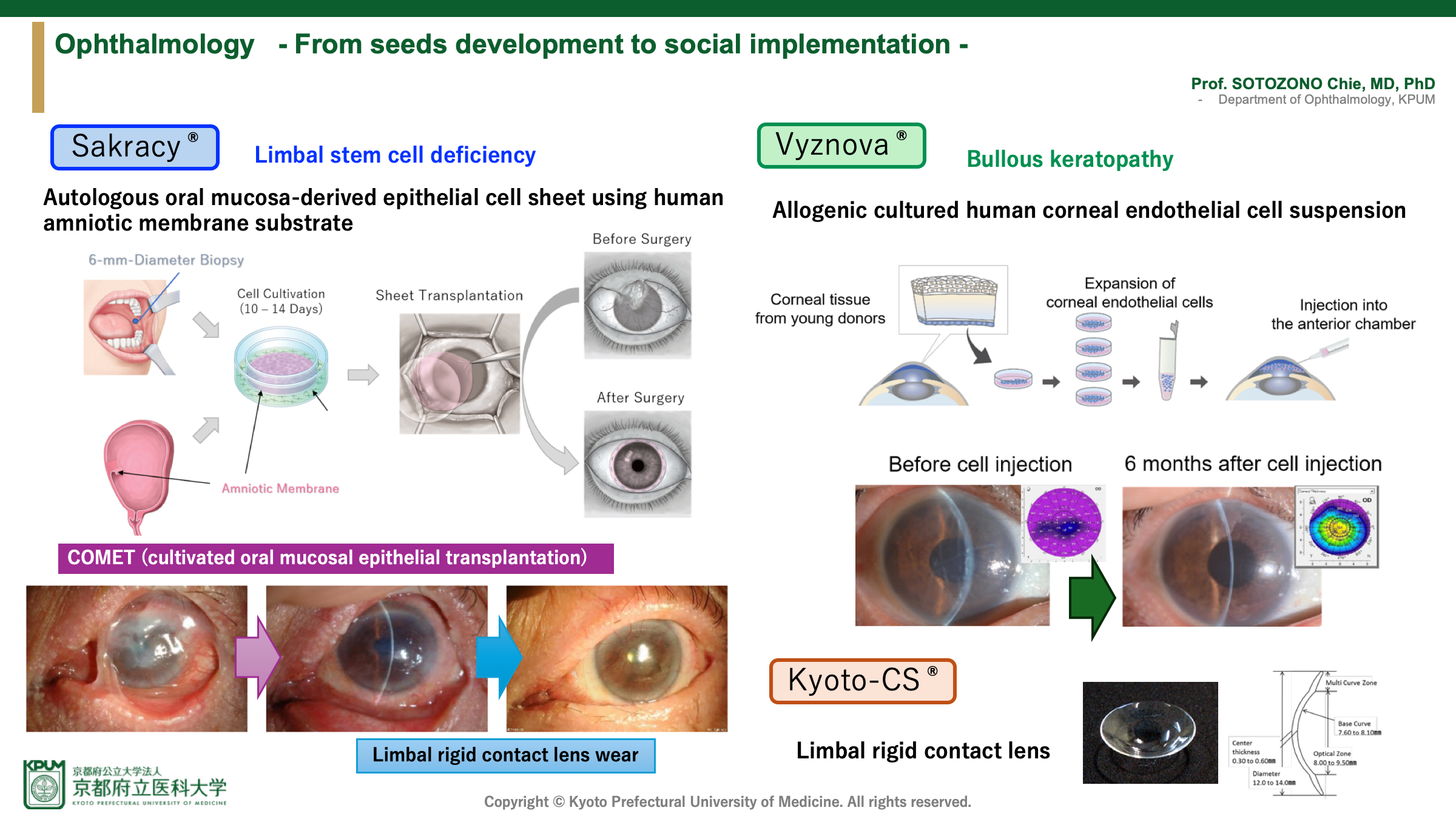
At the department of ophthalmology, the Kinoshita–Sotozono group has worked continuously from basic research to clinical research, clinical trials, and ultimately social implementation. As a result of these efforts, we have successfully obtained regulatory approval for two regenerative medicine products and one medical device.
The first regenerative medicine product is Sakracy®, a cultivated autologous oral mucosal epithelial sheet for the treatment of limbal stem cell deficiency (LSCD). Oral mucosal epithelial cells are harvested from the patient, expanded on an amniotic membrane substrate for approximately two weeks, and then transplanted onto the ocular surface to reconstruct eyes severely damaged by LSCD.
The second product is Vyznova®, an allogeneic cultured human corneal endothelial cell suspension for the treatment of bullous keratopathy. After removal of the diseased corneal endothelial cells, cultured endothelial cells are injected into the anterior chamber. By maintaining a face-down position for approximately two hours, the transplanted cells attach to the posterior corneal surface. Once functional, they restore endothelial function, reduce corneal edema, and improve vision.
We have also developed a medical device called Kyoto-CS®, a limbal rigid contact lens with a unique design. Tear fluid is retained between the lens and the cornea, creating a smooth optical surface and improving visual acuity.
Following COMET surgery, this lens can further stabilize the ocular surface and enhance visual rehabilitation.
Together, these technologies have transformed previously untreatable blindness into treatable conditions, offering new hope for patients with severe corneal disease.
At KPUM, we do not stop at discovery; we translate. Our Ophthalmology department proves our capacity for global commercialization.
A prime example is Vyznova. Developed by Professor Kinoshita and out-licensed to Aurion Biotech, it is the world’s first allogeneic cell therapy for corneal endothelial disease. Because we can propagate fully differentiated cells, a single donor cornea can now be expanded to treat as many as one thousand eyes.
Granted both FDA Breakthrough Therapy and RMAT designations, it demonstrates exactly how KPUM scales biotechnology to cure previously untreatable blindness.
Research Inquiries
For inquiries regarding the research profiles featured on this page,
please contact us at:



